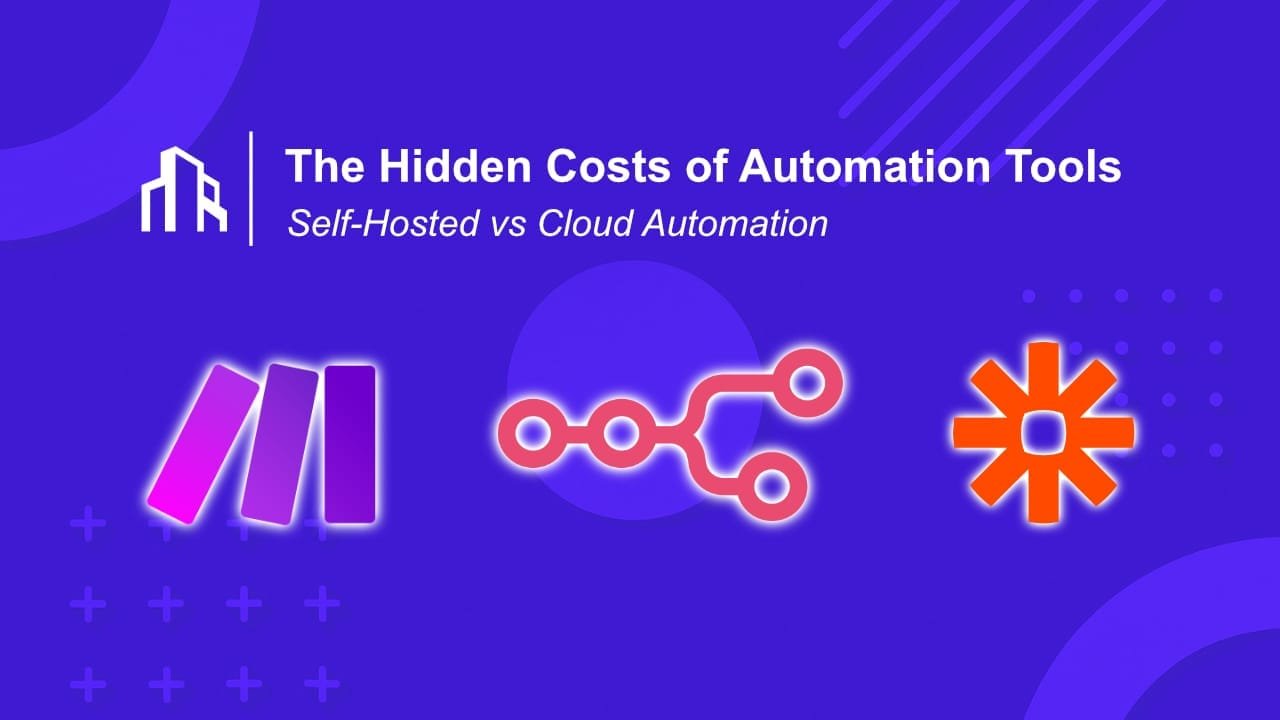
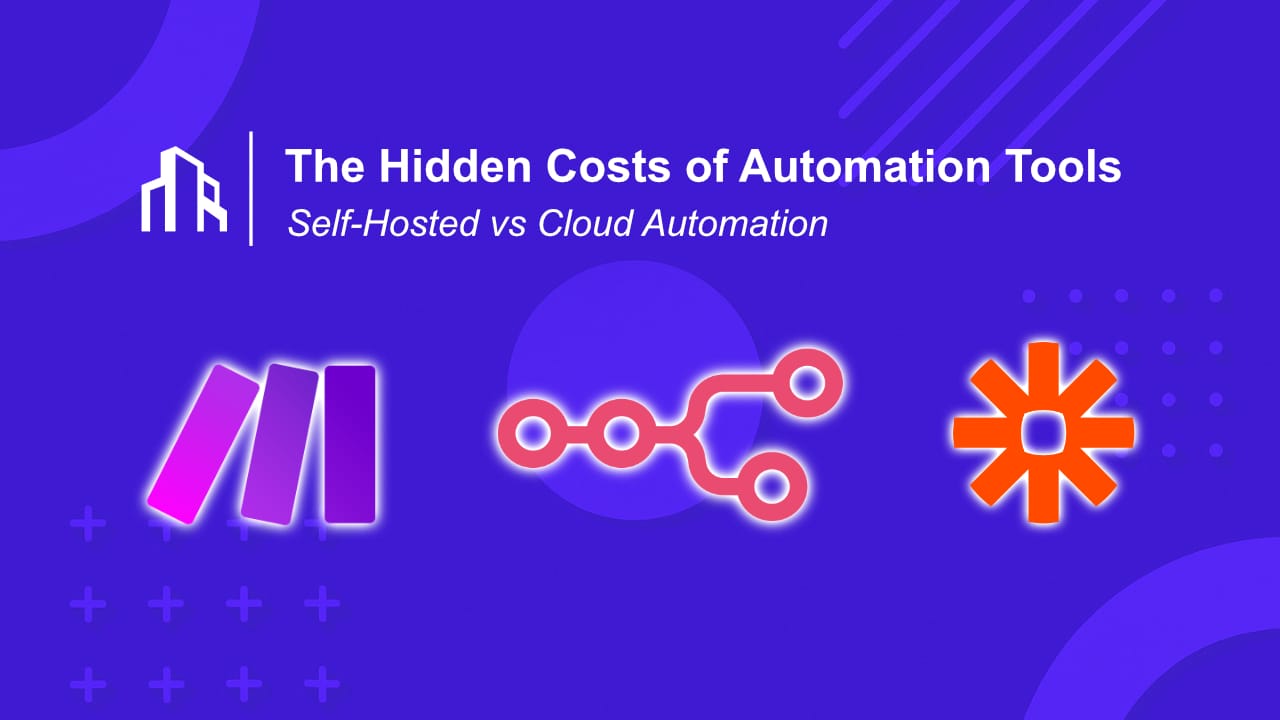
Self-hosted automation is often seen as a cost saver. Teams choose n8n over Make or Zapier thinking they’ll eliminate monthly SaaS fees and gain full control.
In practice, the financial picture is more complex. The hidden costs of infrastructure, maintenance, and compliance often exceed what teams would pay for a managed platform.
This article provides a breakdown of real-world cost ranges, operational overhead, and decision criteria every enterprise should consider before self-hosting automation tools.
1. n8n: Open Source Flexibility, Enterprise Price Tag
Positioning
n8n is open-source and can be self-hosted on your own infrastructure. It offers full flexibility, advanced logic, and no credit-based limits. It’s ideal for technical teams with strong DevOps support.
Cost overview
| Category | Estimated Monthly Cost | Notes |
|---|---|---|
| Cloud infrastructure (VMs, storage, DB) | €80 – €250 | Based on 2–4 CPU instance + backups |
| Maintenance (DevOps time) | €400 – €800 | 4–6 hours per week average |
| Security patching & monitoring | €100 – €300 | Depends on enterprise compliance needs |
| Support / downtime mitigation | €100 – €200 | No official SLA unless paid plan |
| Total (typical enterprise) | €700 – €1,500+ | Excluding internal labor for workflow design |
Hidden costs
- Scaling: Worker queues and Redis setups add infrastructure complexity.
- Compliance: GDPR, ISO 27001, and SOC 2 require internal controls.
- Upgrades: Breaking changes across versions often need manual patches.
- People time: Each new workflow must be manually tested and deployed.
2. Make: (formerly Integromat) Pay for Ease, Not Ownership
Positioning
Make offers visual automation as a service. It’s cloud-based, easy to start, and includes built-in scaling, but costs increase sharply with usage.
Pricing tiers (as of 2025)
- Core plan: €9/month – 10,000 operations
- Pro plan: €29/month – 100,000 operations
- Teams plan: €99/month – 1M operations
- Enterprise: custom pricing starting at €1,000/month
Hidden costs
- Credit overuse: Large automations can burn through 1M operations quickly.
- Limited transparency: No server-level insight or version control.
- Vendor dependency: Proprietary logic makes migration expensive.
- Data control: Sensitive data always processed through Make’s servers.
When it’s cheaper than self-hosting
For small or mid-sized teams running <300,000 operations/month, Make is often cheaper and faster to deploy. But at scale, recurring credits can exceed €1,000 per month, without true infrastructure control.
3. Zapier: Simplicity at a Premium
Positioning
Zapier dominates the no-code market. It’s perfect for marketing, CRM, and basic automation between SaaS tools. It requires no technical setup but becomes expensive fast.
Pricing (2025)
- Starter: €29/month (20 Zaps)
- Professional: €73/month (Unlimited Zaps, 2-minute update time)
- Team: €115/month (Shared workspaces)
- Company: €595+/month (Advanced admin + SSO)
Hidden costs
- Limited logic: No loops, branching, or advanced data handling.
- Execution throttling: Higher-tier plans still limited by task frequency.
- Scaling limits: Thousands of tasks per day can require multiple premium accounts.
- Debugging time: No detailed logs or custom retries.
Real enterprise cost
A midsize team (5–10 users with 50–100 automations) can easily spend €400–€700 per month, not counting overlapping tools like Airtable, Slack, or Google Workspace APIs.
4. Comparing Total Cost of Ownership (TCO)
| Platform | Monthly Cost (Typical Enterprise) | Strength | Weakness |
|---|---|---|---|
| n8n (self-hosted) | €700 – €1,500+ | Control, flexibility | Maintenance, compliance |
| Make | €100 – €1,200 | Ease, visual UI | Vendor lock-in, credit model |
| Zapier | €70 – €700 | Accessibility | Costly scaling, logic limits |
Observation
- n8n shifts cost from software to people and infrastructure.
- Make offers a middle ground but punishes high-volume automation.
- Zapier suits lightweight workflows but not enterprise-grade scaling.
5. The Governance and Compliance Layer
Hidden costs aren’t only financial they’re operational.
Enterprises must budget for governance around:
- Audit trails — essential for regulated industries.
- Access control — Make and Zapier have limited role-based access.
- Data residency — self-hosting supports EU-only processing; SaaS tools may not.
- Monitoring and versioning — crucial for reliability but rarely included.
These factors affect not only cost but also risk exposure and scalability.
6. When Self-Hosting Makes Sense
Self-hosting pays off when:
- You process sensitive or high-volume data daily.
- You have an in-house DevOps team to maintain uptime.
- You require custom logic or on-prem integration beyond SaaS limits.
- You want full control over cost scaling and data flow.
For everyone else, a managed SaaS platform may be more cost-efficient and less risky even if it looks more expensive on paper.
7. Conclusion
Automation isn’t just about tool selection; it’s about long-term operational economics.
Enterprises that choose n8n for cost reasons often spend more in labor and reliability management than expected. Conversely, those that overinvest in SaaS tools like Zapier may pay for simplicity they don’t need.
The smartest choice depends on your data sensitivity, workflow volume, and team maturity.
Before deciding to self-host or migrate, simulate your real usage, factor in DevOps costs, and evaluate compliance requirements.
Want to calculate your real automation ROI?
Contact Scalevise for a transparent cost-benefit assessment and architecture plan tailored to your business.